My Great-Grandmother, Eva, is a bit of mystery. Not even a photo of her exists.
The only story I know about her, from Aunt Arlene, is that she had a temper - and she was nuts.
She would get so upset she would smack her kids around with skillets and the only thing that would calm her down was vanilla ice cream. Aunt Arlene recalled several late nights of running out for ice cream (along with Uncle Steve whom she was dating at the time) so she'd stop beating the kids.
Showing posts with label Maternal. Show all posts
Showing posts with label Maternal. Show all posts
Sunday, December 14, 2014

Marge
I didn't know my maternal Grandmother but despite dying suddenly at age 53, she lived a colorful life.
She was born Margaret Mary on April 11, 1922 in Cleveland, Ohio. The circumstances of her early years can be found in previous blogs (See Tag: Evans).
Her friends and family called her Marge. She went to South High School and was quite popular. During a game in which her school played Holy Name, my grandfather asked her out. She had been asked out by a suitor from her home team and eventually declared she'd go with whomever's team won. My grandfather's team won.
In 1943 she enlisted in the Women's Army Auxiliary Corps. According to a cousin she did this by running away to Columbus, and was then stationed in Florida. She did this due to an affair with a married man gone wrong. After 3 months she was discharged due to a skin condition the Army was tired of attempting to treat despite the humid location aggravating it.

She married my grandfather and raised 4 kids.
On 4th of July weekend in 1975, she suddenly died to a ruptured cerebral aneurysm.

She was born Margaret Mary on April 11, 1922 in Cleveland, Ohio. The circumstances of her early years can be found in previous blogs (See Tag: Evans).
Her friends and family called her Marge. She went to South High School and was quite popular. During a game in which her school played Holy Name, my grandfather asked her out. She had been asked out by a suitor from her home team and eventually declared she'd go with whomever's team won. My grandfather's team won.
In 1943 she enlisted in the Women's Army Auxiliary Corps. According to a cousin she did this by running away to Columbus, and was then stationed in Florida. She did this due to an affair with a married man gone wrong. After 3 months she was discharged due to a skin condition the Army was tired of attempting to treat despite the humid location aggravating it.
She married my grandfather and raised 4 kids.
On 4th of July weekend in 1975, she suddenly died to a ruptured cerebral aneurysm.
Tuesday, November 25, 2014
DNA
I wanted to share some of my results between myself, my mother, and my father's first cousin (my first cousin 1x removed).


Sunday, November 16, 2014
Presidential Memorial Certificates
I learned about this service this past week. Thought I'd pass it along.
Still hunting for the death certificate for my Grandma Marge but I've mailed in requests for the others.
The link is pretty self-explanatory.
Still hunting for the death certificate for my Grandma Marge but I've mailed in requests for the others.
The link is pretty self-explanatory.
Sunday, November 2, 2014

Thursday, October 30, 2014
Aunt Edith
I have a love/hate relationship with the next relative I want to share a bit about.
Edith Evans was the older sister of my maternal grandmother. She married her husband, James Sullivan, at age 16. Her daughters were Anna Mae & Lois.

When Edith’s mother, Mary died, my grandmother was 12 years old and lacked any other female figures. Her father and brothers did their best to raise her.
Growing up, I was told Edith was “cruel”, “nasty”, “unkind”, and “not just to your grandmother Marge but to her own children, poor Anna Mae “. It remains unknown to me if she was physically, mentally, emotionally, or all of the above abusive towards the girls.
Edith died in 1962 following a stroke she suffered some time prior.

Tuesday, October 7, 2014
Cousin Skinner
Skinner aka Patrick Joseph Logan was my Great-Great-Uncle.
I don't know much about him except he came over with my Great-Grandmother, Mary Logan Evans, from Ireland when they were small.

I don't know much about him except he came over with my Great-Grandmother, Mary Logan Evans, from Ireland when they were small.
I'm not sure why he was called Skinner or why we all call him cousin instead of uncle.
d#: 0208702
Name: Logan, Patrick J. (Skinner)
Date: Jan 13 1949
Source: Source unknown; Cleveland Necrology File, Reel #050.
Notes: Logan, Patrick J. (Skinner), beloved husband of Emma (nee Godenschwager); father of Mrs. Farrell Finnerty (Bertha), James, Doris; brother of Catherine Parderski, Agnes Herbison, and grandfather; at his late residence, 9309 Bancroft Ave. Friends received at James P. Mullancy Funeral Home, 9811 Miles Ave. Funeral Friday, Jan. 14. Holy Name Church, 9:30 a. m.
Sunday, September 21, 2014
The Library Cleaner
My mother's grandfather was Issac Evans. Isaac was a twin and the youngest of many born to Welsh immigrants in Cleveland. His parents William & Christianna immigrated from Wales.
Isaac worked as a fireman, labor jobs, and most notably - a library custodian at the Miles Park Branch.
Isaac suffered memory lapses in his later years and not much is known about his family. He died in 1945 and is buried with his wife, Mary, in Calvary Cemetery.

Monday, August 25, 2014
A wee bit 'o Irish
As a child I knew very little about my Irish roots. In fact, that I was Irish at all. If my sister & I spent St. Patrick's Day with our father he would make the comment that we were the only Irish in the house. One year he was challenged by my step-sister Dawn, " how are they Irish? ". I listened that time.
Eventually I knew the facts. My maternal grandmother was 1/2 Irish from her mother. Technically that made me 1/8th. In middle school I met a friend that was full Irish. Really. Her grandparents were fresh off the boats. I went to the Westside Irish American club. I ate Irish food. I went to the St. Patrick's Day parade, etc. All with the family of this friend. It was more than my family had ever taught me about my "Irishness".
I'd venture to say I'm closest to my Irish line for the simple reason that it's my mitochondrial DNA (mtDNA). mtDNA is passed down the female line. Although males receive a copy from their mother's, they do not pass it on. It also has a much slower mutation rate.
My maternal grandmother was an accident and was 20 years younger than her eldest sibling. Her mother's name was Mary Logan Evans and she died when my grandmother was 11 years old due to kidney failure. She died in August 1933 in Cleveland, Ohio and was only 53 years old. Since she died when my grandmother was so young, little was known of Mary.
This is what I know of Mary from oral history and my own research:
Mary was born to John Logan & Agnes Quinn in County Cork Ireland; however, conflicting records also show her born near Downpatrick Northern Ireland in October 1878 or 1879.
Her father, John, first left Ireland for the US. Her mother Agnes set sail at a later date, departing from England, arriving with Mary and two brothers (Patrick & John) in 1883. Mary was 5 years old and as a result, could recall very little of her time in Ireland.
Once in the US she raised Belgian Malinois for Cleveland PD. No known photos or personal stories about her exist. She was interred at Calvary Catholic Cemetery in Cleveland, Ohio.
d#: 0093040
Name: Evans, Mary
Date: Aug 1 1933
Source: Source unknown; Cleveland Necrology File, Reel #023.
Notes: Evans: Mary, beloved wife of Isaac Evans, mother of Mrs. James Sullivan, Williams, Albert, John and Margaret Evans, sister of Patrick Logan, Mrs. X. F. Pasdersky and Mrs. Stewart Herbison, at her residence, 9321 Cassius Ave. Funeral Saturday, Aug. 19. Services at Holy Name Church at 9 a. m.
Sunday, August 10, 2014
Giants Among Us
I've been a bit behind but today I caught up. When I looked in my book, I smiled, and then I didn't know what to say.
What do you say about a woman that was so great? A woman that wasn't a giant amongst women but a giant amongst humans? I truly mean that. She was wonderful.
I've previously documented how I came to correspond with her. I was transferring an old address book and was curious about this old timer Polachek still alive.
Her name was Arlene. In blood she wasn't my aunt but that didn't matter. She was married to, had children with, and deeply loved my Great-Uncle Steve. Blood or not, she was my family.
Aunt Arlene was born a Dahm to a (mostly) German family. She had two sisters named Audrey and Germaine. I don't quite recall how she met Uncle Steve but I believe it involves a friend of a friend with school.
She said growing up during WWII she didn't face any anti-german sentiment but confessed most of her time was spent worrying about Uncle Steve.
My mom tells great stories of spending time at her house. Uncle Steve apparently liked to " temporarily " fix things. Aunt Arlene would beg him to call my grandfather but alas no. (My grandfather was a Mr. Fix-it type!) He would relent and she said in one letter, " If I had a penny for each time I said " Please call Frank!" ".
In her lifetime she buried her sisters, a child, her husband, various friends, and various family members.
This story always stuck with me, and I'm not sure why but I luckily have the original letter still.
What do you say about a woman that was so great? A woman that wasn't a giant amongst women but a giant amongst humans? I truly mean that. She was wonderful.
I've previously documented how I came to correspond with her. I was transferring an old address book and was curious about this old timer Polachek still alive.
Her name was Arlene. In blood she wasn't my aunt but that didn't matter. She was married to, had children with, and deeply loved my Great-Uncle Steve. Blood or not, she was my family.
Aunt Arlene was born a Dahm to a (mostly) German family. She had two sisters named Audrey and Germaine. I don't quite recall how she met Uncle Steve but I believe it involves a friend of a friend with school.
 |
| Aunt Arlene flanked by her sisters. |
She said growing up during WWII she didn't face any anti-german sentiment but confessed most of her time was spent worrying about Uncle Steve.
My mom tells great stories of spending time at her house. Uncle Steve apparently liked to " temporarily " fix things. Aunt Arlene would beg him to call my grandfather but alas no. (My grandfather was a Mr. Fix-it type!) He would relent and she said in one letter, " If I had a penny for each time I said " Please call Frank!" ".
In her lifetime she buried her sisters, a child, her husband, various friends, and various family members.
This story always stuck with me, and I'm not sure why but I luckily have the original letter still.
A couple of years after Steve died I attended a funeral for a friend - really more just a coworker, of his that we were friendly with. At the funeral I saw the man's wife and she made the comment to me that Steve & her husband were having a great time up in heaven partying. Meanwhile, we were down here miserable. A few years later, she died and I felt like gee thanks for the support.I miss you Aunt Arlene, as does your immediate family, and anyone that was lucky enough to have known you. Till we see you again.
Lois Sullivan McBride
Lois was, technically, my grandmother's niece; however, they were about the same age. She and her sister Anna Mae grew up very close to "Marge" aka my grandmother! I've been told the girls were much like sisters.


I MUST have met Lois once and it was likely at Anna Mae's funeral. At the time, I was about 10 years old and don't recall significant details. Her son, cousin Jim, was kind enough to send me some photos her.
Lois was quite a beautiful woman and Jim said the three girls looked quite a bit alike:) She and her husband raised two boys together. Lois passed away in 2001.
 |
| I see the resemblance to my grandmother here! |
 |
| With her husband and boys. |
Saturday, July 19, 2014
The Kind Soul of Uncle John
John Evans was my mother’s Uncle.
As a child he fell ill and the Pazderski’s nursed him to back to life. He was reportedly never the same or “right” in the head.
 |
| Chauffeur's License (he looks rather Johnny Cash in the first photo!) |
 |
| Photo Booth Uncle John |
 |
| Death & Birth Certificates |
Uncle John lived with the family his entire adult life at the house on Cassisus. He worked a variety of jobs and helped contribute to the family. One job included working as a chauffeur. According to cousin Jim, he bought the first color TV. The first one on the street!
My mom says Uncle John was a kind man, he always took care of the family even though he was independent (although still living with them).
Friends and family - share with me your best Uncle John stories in the comments!
Thursday, July 10, 2014
The Gassman
The letter from him always concluded “ Love your much (underlined 4x) older cousin Joe & Bernie “.
Joe was my mother’s cousin from her Aunt Katie. He was an only child. Quite a mix you could say. His mother, Katie, was Ukrainian and his father was Italian. That made Joe, Italian Ukrainian. Quite a mix, quite a mix!
He was about 20 years old than my mother but never treated her inferior or provided any less love.
Mom says he travelled to Asia at some point and Joe let her borrow his outfit for her performance.
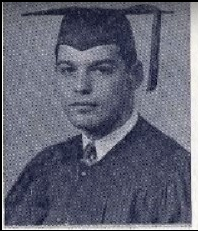 |
| Joe when he graduated High School. |
This must have been the winter of 1984 when Grandma Leota died. As my parents have received some inheritance they replaced the windows in the house. Unsurprisingly, the gas bill dropped due to the new energy efficient windows. Unknown to my family, it alerted the gas company that we might be cheats. Thus, the relentless checking of the meter began. Cousin Joe was an executive with the gas company and mom gave him a call.
After my mother had enough and enlisted Joe’s help, it stopped. We all laughed they never took the time to ask or consider that the house may have changed.
I never personally met him but corresponded with him several times until his death in 2008 from Parkinson’s. His wife Bernie (Bernadette) had passed a few years prior. He always sent me congratulation, birthday, milestone, etc cards. He had his own family of growing kids and grandkids but I found it endearing he took him to remember us as well. Mom says he learned Aunt Katie's skills. He was Aunt Katie 2.0 , he learned her unnatural ability to convey love and warmth.
Raise a glass to cousin Joe, he was one of the greats!
Monday, July 7, 2014
Beer here!
 |
| Martha Polachek Lynch (the only photo I've ever seen or have of her).
Martha Polachek Lynch was my Grandfather's older sister. She married but had many still born babies. From what I've been told, she was extremely close with her older sister, Katie. She died in 1977.
I wanted to share the story my mother always recalls about her:
Aunt Martha would ask the kids to go get the beers out of the basement fridge. (Typically, at a family gathering while the adults were discussing and carrying on in the sitting room.) Uncle Frank (my mother's brother) & my mom would shake the hell out of Aunt Martha's beers and each time - they blew up in her face when she went to open them. Aunt Martha never complained and would laugh at the top of her (probably drunk or tipsy) lungs.
|
Tuesday, June 24, 2014
The End (for now)
Before I launch into the story I thought it best to explain a bit about each person. Please note, this is not an exhaustive list.
Gerald - He was 18 years old on June 6, 1944 and was the soldier that shot Nick.
Jules Levavasseur - He was 18 years old when Nick, badly wounded, & Gerald came to the farm.
Cecile Levavasseur - The sister in law of Jules who was not at the farm that night but knew the story.
Marie-Therese Levavasseur - The daughter of Jules.
Jocelyne - A Fresville local I found online that guided us.
Bobby - Jocelyne's neighbor. He is very active in the Normandy area and was a teenager during the invasion. He worked at the first temporary cemetery. Bobby was a friend of Jocelyne's grandfather.
Rene - Our Normandy guide. His father was a member of the French Resistance captured and survived Dachau. He lives in Caen.
Dutch Schultz - A fellow soldier (depicted in The Longest Day) that served with Nick & Gerald.
Ellen - The daughter of Nick's late widow, Melba.
____________________________________________________________________
My immediate question was, how did they they get Nick to the farm? What happened as he died? Who was there? I wanted to know everything.
Before we left, I talked to Ellen. I asked her about Nick's burial flag & medals but she never answered. She did tell me she knew nothing of Nick except he and her mother were very much in love. I then shared with her some of Melba's letters.
Unfortunately, Facebook is not permitting me to share the (poor) quality videos but seeing where Nick died answered many of these questions.
On June 5, Rene picked us up from our hotel in Paris for the 3 hour car ride to Bayeux. Upon arriving in Bayeux we were taking the train to Carentan to meet Jocelyne. We were not sure what to expect and with only a bit of language barriers with locals, we bought our tickets. The ride was 2 stops, 30 mins total.
Immediately, we saw traffic was crazy. We drove to Sainte-Mere-Eglise to meet Cecile. She and an older gentleman met us. They live across the street from the historic church John Steel was stuck on. Jocelyne translated. Cecile pulled out the article on Jules that Jocelyne had written, we all laughed. Cecile had the version of events that Nick was 18 and shot by a German bullet. Indeed Marie-Therese had emailed me this version; however, by Jules' (and Gerald's) own account this wasn't the case. Nick was also 28 and not shot by German fire. Perhaps time or a game of telephone caused this miscommunication.
None the less Cecile pulled out a map and sheet to show us Nick's grave. She had been to visit him at the American Cemetery at least 4 times and had a rubbing of the grave. At the end of the visit we gave each other awkward air/cheek kisses and I presented her with a photo of Nick. She was very pleased to have it.
From there we snapped a few photos of the church as a procession marking a new historic marker instillation was leaving. It was wall to wall people. As we were early on time, we went near Utah Beach. We walked in the sand and collected shells. Then we went to meet Bobby.
On the way Jocelyne turned and said , " Do you think you will come back? ". At that moment I knew the answer was yes. She told me I'd love to look into all the local archives which might even have more about Nick. We stared at the country roads that she wound with ease - one lane roads with brutal blind spots.
Fresh off of leaving the church ceremony, we met Bobby at his home in Fresville.
Approximately 15 years ago he got a call about an American wandering around the area with a sketch (that he had made) of a building he was trying to find. Bobby was called in to translate and learned this man was trying to locate a farm he had shot his friend Nicholas on in 1944. It was Gerald. They searched in vein for several days and Gerald left empty handed.
Several years later Gerald returned and the search resumed. As they were heading near a chateau (used as a medical rally point and the site of fierce fighting by a soldier named Turnbow) they came across an elderly man using clippers to trim the hedges. They pulled up and asked the man and said the story. He said nothing and kept cutting his hedges. Finally he said, I think I might know the place. " Can you ask the man that was there if there was a young man there that night and what did he ask him?". Confused Gerald answered yes there was a young man there and he asked him how old he was. He remembered the young man was 18 because they were the same age. With that the man identified himself - it was Jules Levavasseur.
Gerald then told him that when Dutch Schultz was dying he called Gerald and asked him to come see him - he had something important to tell him. According to Gerald they talked about Nick (or just Polachek as they called him). Nick, Gerald, and Dutch were all gambling together before they left for Normandy. Gerald still owed him money and insisted on paying him. Dutch refused and they agreed to send it to their company chaplan. Gerald left and realized he didn't know what it was Dutch wanted to see him about but when he walked back in, Dutch had died.
All three (Bobby, Jules, Gerald) later went to the farm.
Jocelyne bid us adieu at this point and we headed with Bobby to the farm.
Nick & Gerald landed approximately 20 ft behind the house in a hedgerow. One on each side. Nick was shot on his left side in the lower part of the stomach as he tried to pass the radio. Therefore, it's assumed he landed on the side of the headrow closest to the house. The Levavasseur's took him into the home and placed him on a mattress. Somehow, they were able to find a medic. He said if the bleeding was not internal Nick would be ok, one look at the wound and they knew he was doomed. Nick didn't survive for long and Gerald stayed with him as he died.
I wonder if Nick said anything - tell my family I love them? Take my tags home to my family? Did Gerald beg Nick's forgiveness?
The family wrapped Nick in their linens and with the help of Gerald buried him in the back garden. A plum tree stands there today. Rene told us that the Levavasseur family took a great risk at burying Nick. Luckily it was a private burial so it was not discovered but had it been discovered by the Germans, they could have paid a heavy price.
Gerald has not been returning calls or messages and Bobby feels he is busy trying to forget. I have strong feelings about this but will omit them for now.
As we were talking about coincidences - Nick's grave is C-28-28. Nick's grave location was randomly selected by ABMC. My grandfather is buried in section 23-23 of Calvary and was 5 years younger than Nick. The graves are each 5 apart. Coincidence? Not to mention my mother shares a birthday with Nick's wife and I share a birthday with Nick's father. Someone upstairs orchestrated all of this. How or why, I'm not sure but I know in my heart we will be back to France. My mom feels it in her heart too. Our main mission is accomplished but cementing Nick's legacy is my new focus.
As Bobby dropped us off at the train station he mentioned that he saw flowers at Nick's grave a few days ago. He believes a professor nearby had adopted his grave and would make inquiries for us. We promised Jocelyne & Bobby we would all keep in touch. I hope to return to France and see them both. They kept saying don't thank us, this is a honor.
The next day started at 3am. We finally got to meet Uncle Nick at Normandy American Cemetery. I will make another entry but I placed my hand on his grave, fought back tears, and just kept thinking " I'm so sorry this happened to you - you should have come home - we all love you - we are so proud but so sorry this happened to you.". Mom later told me she kept saying the same thing too - she was so sorry it happened to him. I know without a shadow of a doubt my Grandma Marge & Grandpa Frank were there in spirit. They would be so proud, I can hear my Grandpa saying " Nick, meet my girls." with a big grin on his face.
I will try to double check this later for typos and such. My mac is running slow and freezing up - that includes my patience at this point!
Sunday, June 22, 2014
The beginning until 0203 on June 6, 1944
I didn't want to write this because the story should not have ended the way it did. I should properly footnote this but I'm feeling a bit too lazy for that. Many of you have asked, have you updated your blog yet? I'm actually only about a week behind even though I haven't updated in a month (per my own schedule). Returning from France, I am getting over a cold and recovering in general. This is going to be a lengthy entry and as it was expanded in France - it will now be two parts.
A lot happened in France, for Nick - for Mom & I as well.
I know many more details but I thought it best to include those in details of the chaos and the beginning of the end for Nick that I now know started , almost the instant he landed, in the forthcoming entry.
My great-grandparents fled Galicia in search of a better life. Louis arrived in 1902 and his wife, Julia, a short time after. The family settled in Cleveland (supposedly due to the strong presence of Slav's). The family was Byzantine Catholic but just "became" Roman Catholic. They had 8 children: Wesley, Mary, Mike, Katie, Martha, Nick, Steve, and Frank. From Wesley to Frank ( my grandfather) there is a 20 year age gap.
Louis supposedly served mandatory military service in Galicia before he left. Admittedly, I know very little about how the kids were raised. I know Julia was "bat shit". She would get so worked up that the children went out at all hours of the night to obtain the one thing that could calm her down, not to mention stop her from beating the kids with a skillet, vanilla ice cream was her kryptonite.
Louis & Julia never went to school. They could not read or write their native Ukrainian let alone English. They relied on the children as translators; however, my mother never heard her father (or his siblings) speak it.
Mary dropped out of school in the 6th grade to help out at home. Each child progressively increased their education level. Nick graduated from a public high school. His younger brother Steve scored a scholarship to a private Catholic School due to athletics. My grandfather followed suit. The boys went on to college - until war called that is.
Circa 1942, Nick married a local girl from the neighborhood - Melba who was a few years his senior. Both families went into an uproar. Melba's family was Jewish. As Aunt Arlene put it, " Good Catholic boys married good Catholic girls & visa versa. It was ok for the kids to play ball in the neighborhood but not marry.". Nick & Melba never had the chance to live together. On November 7, 1942 - Nick was drafted.
It's unknown to me if he volunteered for Airborne and if so what his motives were. My best guess is that he volunteered because Paratroopers received additional pay at approximately $100 more per month. It may not seem like a lot but at the time it was - it was more money they could send back home.
Nick went through jump school in either Alabama or Georgia. On February 10, 1943 the 505th was sent to Ft. Bragg. On March 21 they were moved to Camp Edwards in Massachusetts.
After basic training Nick departed the Port of NYC bound for Casablanca in April 1943 where he arrived on May 10. He received more training.
The rest was quite routine for as far as invasion go. Sicily : Operation Husky. Salerno : Operation Avalanche.
After the invasion of Sicily Nick was awarded a Combat Infantryman Badge; however, the the orders were not cut until 1944 when the unit returned to England. Following Salerno Nick went missing for 28 days. He was reportedly dropped too far north into the mountains before he found his way back to the unit.
The unit then moved to England to prepare for Mission Boston, which was a component of Operation Neptune - the assault and landing phase, the opening maneuver the aptly named, Operation Overlord.
Specifically Nick was at Spanhoe RAF. The last letter that made it home was a letter to his sister Katie, he didn't know what yet, but it is clear that he knew an invasion was coming. That was the last time the family heard from him.
The 505th would be transported by the 315th TCG. They would be sent to DZ O near Sainte-Mere-Eglise with specific objectives.
A lot happened in France, for Nick - for Mom & I as well.
I know many more details but I thought it best to include those in details of the chaos and the beginning of the end for Nick that I now know started , almost the instant he landed, in the forthcoming entry.
My great-grandparents fled Galicia in search of a better life. Louis arrived in 1902 and his wife, Julia, a short time after. The family settled in Cleveland (supposedly due to the strong presence of Slav's). The family was Byzantine Catholic but just "became" Roman Catholic. They had 8 children: Wesley, Mary, Mike, Katie, Martha, Nick, Steve, and Frank. From Wesley to Frank ( my grandfather) there is a 20 year age gap.
Louis supposedly served mandatory military service in Galicia before he left. Admittedly, I know very little about how the kids were raised. I know Julia was "bat shit". She would get so worked up that the children went out at all hours of the night to obtain the one thing that could calm her down, not to mention stop her from beating the kids with a skillet, vanilla ice cream was her kryptonite.
Louis & Julia never went to school. They could not read or write their native Ukrainian let alone English. They relied on the children as translators; however, my mother never heard her father (or his siblings) speak it.
Mary dropped out of school in the 6th grade to help out at home. Each child progressively increased their education level. Nick graduated from a public high school. His younger brother Steve scored a scholarship to a private Catholic School due to athletics. My grandfather followed suit. The boys went on to college - until war called that is.
Circa 1942, Nick married a local girl from the neighborhood - Melba who was a few years his senior. Both families went into an uproar. Melba's family was Jewish. As Aunt Arlene put it, " Good Catholic boys married good Catholic girls & visa versa. It was ok for the kids to play ball in the neighborhood but not marry.". Nick & Melba never had the chance to live together. On November 7, 1942 - Nick was drafted.
It's unknown to me if he volunteered for Airborne and if so what his motives were. My best guess is that he volunteered because Paratroopers received additional pay at approximately $100 more per month. It may not seem like a lot but at the time it was - it was more money they could send back home.
Nick went through jump school in either Alabama or Georgia. On February 10, 1943 the 505th was sent to Ft. Bragg. On March 21 they were moved to Camp Edwards in Massachusetts.
After basic training Nick departed the Port of NYC bound for Casablanca in April 1943 where he arrived on May 10. He received more training.
The rest was quite routine for as far as invasion go. Sicily : Operation Husky. Salerno : Operation Avalanche.
After the invasion of Sicily Nick was awarded a Combat Infantryman Badge; however, the the orders were not cut until 1944 when the unit returned to England. Following Salerno Nick went missing for 28 days. He was reportedly dropped too far north into the mountains before he found his way back to the unit.
 |
| The telegram announcing Nick was unaccounted for in Salerno. |
Specifically Nick was at Spanhoe RAF. The last letter that made it home was a letter to his sister Katie, he didn't know what yet, but it is clear that he knew an invasion was coming. That was the last time the family heard from him.
The 505th would be transported by the 315th TCG. They would be sent to DZ O near Sainte-Mere-Eglise with specific objectives.
This report is taken from the book "THE THREE ONE-FIVE GROUP", written in 1968, and published in 1984, by now-deceased Bill Brinson. It is now being expanded for reissue late 2002.
The last week in May, Group Engineering received numerous gallons of both black and white paint. Confidential instructions were issued to the four squadron engineering sections to be ready on short notice to mark all aircraft. Three white and two black stripes, each stripe two feet wide, were to be painted around the aircraft fuselage just forward of the tail section. The same pattern was to be painted on the top and bottom of each wing. Once the aircraft were painted, they were grounded until further notice. The "GO " signal for the painting to commence was received on 3 June, and the squadron engineering personnel, chided into competition by Sgts. George White and Sollie Grasmick from the Group Engineering Section, worked continuously until all aircraft were marked.Airfield SealedOn 1 June, the airfield at Spanhoe was "sealed:" No one was allowed off the base, all passes were cancelled, and all personal telephone calls were prohibited. Non-official mail was placed in bags and stored. Paratroopers from the 505th Parachute Infantry Regiment, 82nd Airborne Division, stationed near Leicester , began arriving at Spanhoe two days later. They set up cots in one of the hangars and strung barbed wire around the area of the airfield allotted to them. Around the same time, 315th crewmembers scheduled for the upcoming mission were issued "escape kits "containing special instructions, cloth maps, and a limited amount of French francs. These kits were welcomed. Not welcomed were a set of special coveralls, impregnated with an oily and strong smelling substance, which were supposed to be worn on the mission. The impregnated suit was said to offer protection against certain types of gasses that the enemy might use.
The weather forecast for 5 June postponed the planned operations for 24 hours, but on the evening of 4 June, General Eisenhower made the decision that the invasion of France (Operation OVERLORD) would take place on the 6th. The paratroops, advanced guard of the Allied Forces, would take off from English airfields on the evening of 5 June. The mission of the 82nd Airborne Division, of which the 505th PIR was a part, was to secure the western edge of the bridgehead by capturing the town of Ste. Mere Eglise , a key point on the road to Cherbourg.The BriefingsEarly in the afternoon of 5 June, the pilots, co-pilots,and navigators assembled in the Pilots ' Lounge. (The crew chiefs and radio operators were briefed separately.) Maj.Gen.Matthew B. Ridgeway, who commanded the 82nd Airborne Division, and who was scheduled to jump with the 505th was present. When all were present, Col.McLelland announced that the long expected mission was scheduled for that evening. Lt.Col.Gibbons then revealed the map on the wall and pointed out the destination —a drop zone northwest of the town of Ste. Mere Eglise on the Cherbourg Peninsula in Normandy . Over 800 American troop carrier aircraft would participate in the mission, airlifting over 13,000 U.S. paratroopers and glidermen. Additional planes from the British 38 Group and 46 Group would take in the British airborne troops. All necessary information concerning the mission of the troop carriers was fully covered and few questions were asked at the briefing 's conclusion. Pilots went from the briefing to meet and have discussions with the jumpmasters on their respective planes.The total load for the 315th's 48 aircraft was 844 paratroops and 41,236 pounds of equipment. All that was left to do until the balloon went up later in the day was to wait.Channel CrossingA final crew briefing was held at 2030; no major changes were made to the instructions issued earlier. The one serial* of the 315th was to be made up of 48 aircraft —each aircraft carrying 19 to 20 paratroopers, and five to six parapacks of equipment fastened with shackles under the wings.
There was a lead flight of three planes followed by five Vee of Vees , consisting of nine aircraft each. The leader of each nine-plane element was to fly 1000 feet to the rear of the preceding flight. The wing element leaders were positioned 200 feet behind, and 200 feet to the right and left respectively of the rear planes in the leading element. For night flying, this was not a loose formation.
The weather was not too good, but it was not too bad. The skies were expected to be free of clouds over England at the altitude the formation would fly, and only scattered clouds were forecasted for the coast of France.
By 2130 most of the aircrews, paratroopers, and some maintenance men had assembled by the individual planes parked on the hardstands surrounding the airfield. Some were making last minute checks of their planes and equipment;some talked quietly;others remained silent with their own thoughts;all were wondering about what might lie ahead in Normandy . The German forces had worked on "Fortress Europe "for almost four years. Would it be as formidable as the enemy advertised it to be?
There was one group of men whose fate that June evening was not in Normandy , but on the base at Spanhoe. A few minutes before the aircraft were to be boarded, one of the paratroopers standing alongside Flight Officer Weston Harper 's aircraft dropped a grenade. It exploded and sprayed metal fragments in all directions. Two paratroopers were killed instantly and one died later. Fifteen others were wounded, including the aircrew radio operator. The plane received major damage and was pulled from the mission. The handful of paratroopers not wounded, and some who were, tried to get aboard other planes parked nearby at the same time that engines were being started and other planes began to roll to takeoff position. It was reported that one or two succeeded. Such was their training and esprit de corps.
Ninety-Four Engines start up Ninety-four engines began turning over at 2250 and in the order briefed, slowly moved along the taxi strip toward Runway 260. Six aircraft took formation position on the runway, while the others waited to move forward in their turn. Most base personnel not on the planes had an inkling that this mission might be what it happened to be and were assembling on the grass between the control tower and the active runway as if saying "Good luck and Godspeed to all aboard. " At 2306 with ten to fifteen minutes of daylight still remaining, the lead plane of the 315th, piloted by Col. McLelland, started down the runway.
Each five-second interval thereafter, another plane followed the preceding one. The pilots tucked the planes into formation as the serial made a wide sweep of Spanhoe at 1200 feet before taking up a course for " Atlanta , "the 52nd Troop Carrier Wing Assembly Point about 20 miles east of the midlands city of Birmingham . There were two serials from the 316th Group just ahead of the 315th's planes, and seven serials from the 314th, 313th, the 61st, and the 442nd Groups following close behind. These ten serials of 368 aircraft carried the paratroopers of the 82nd Airborne to Normandy.
After darkness, the moonlight above became discernible through high scattered clouds, and on the ground below specially placed light beacons marked the route to the coast every thirty miles. The formation flew southeast until it reached the head of the Severn Estuary, near Bristol , where it turned southward for Checkpoint "Elko. "At Elko, the groups of the other two troop carrier wings moved into the stream at their designated time. After passing the coast over Portland Bill, a descent was made to 500 feet to delay discovery by German radar. Twenty minutes from destination the jumpmaster on each plane was alerted and the formation began a gradual climb to 1500 feet. An unexpected cloudbank was hanging over the western part of the Cherbourg Peninsula that required the 315th to climb a few hundred feet more to get above it and to change course slightly.
As the cloudbank moved away from beneath the formation, the beacons placed on the drop zone by the Pathfinders were identified and shortly thereafter the "T " of green lights was sighted. (The "T, " 30 x 20 yards, was lit shortly before the first serial arrived.) Ground fire was observed off to the right from what appeared to be the town of Etienneville , and one flak burst struck a plane wounding seven paratroopers. Speed was reduced to 110 mph and four minutes before the drop, the jumpmaster standing at the rear of the fuselage received the red lights to stand up and hook up the parachutes to the static line.
As Drop Zone "0, "about three quarters of a mile northwest of the village of Ste. Mere Eglise , was reached, the green lights signaling "Go "were switched on, sending 816 paratroopers floating earthward from the planes of the 315th. The time was 0203 hours, 6 June 1944 . Immediately after the paratroopers were dropped, the planes descended to 200 feet and maintained this altitude until well beyond the east coast of the Cherbourg Peninsula and to the St. Marcouf Islands. Somewhere in this last few miles over the mainland, a 309th aircraft was struck by machine gun fire coming from a house along the route. Lt. R. T. Slater, flying as co-pilot, was slightly wounded and the plane received some damage. Neither Lt. Orien Clark, the pilot;nor Sgts. Prentice Stucker and Rives Graham, the crew chief and radio operator, were injured. Another 309th aircraft, piloted by Lt. Rodney Bemis, received a burst of flak in the fuselage, wounding several paratroopers, three seriously. On the return flight, Lt. Bemis landed at the first English airfield he sighted to obtain medical attention for the wounded.
Climbing to 3000 feet and returning over the Channel, the crewmembers were aware of the tremendous invasion armada spread out below them and moving toward the Normandy beaches. By 0440, 45 aircraft had returned to Spanhoe, and the other two planes had been reported as having landed at other airfields. Twelve of the C-47s had received damage from enemy fire. For the 315th aircrews, at least, what later became known as "The Longest Day " was over.
Wednesday, May 21, 2014
Part I: My journey with Pvt. Nicholas Polachek
I've written and said various things about Uncle Nick over the years, but I always circle back. It always begins the same, " In the early hours of June 6, 1944, Uncle Nick parachuted in German Occupied France and was never heard from again.".
That line was the end of his journey but the start of mine.
It would be easy to start Nick's story at the beginning of his life; however, I'd like to start where I entered the picture to provide a contemporary view.
Growing up, I heard the running joke my father told. It involved members of my mother's family betting friends that they could find the name "Polachek" on the Cleveland Veterans Memorial. We knew the name was there but I had been told we were of no relation.
To provide a bit of context, my mother's parents (Frank & Marge) died before I was born. I never met them or any of their siblings. I knew my mother's sister Kathy (and her children) but didn't know any other members of her family. I didn't meet my mother's brother until I was about 10 and I first learned of her other sister, Linda, around the same age. I'd met much older cousins of my mother's and over the years I've reached out to some other cousins (like my 2nd cousins from her family) but the honest truth is, 99% of the time they don't care to talk or know me.
My parents divorce was finalized in 1988 and my mother moved to Arizona, taking us with her. We returned to Cleveland each summer and every other Christmas to visit our father. He took us to Calvary Cemetery to visit the graves of our Polachek relatives. I remember thinking , " why do I care about visiting these random people I don't know?". When I moved to Cleveland full time, in 1995, I went to school with mostly Polish kids. Somewhere along the line I just assumed my mother's family was Polish because of their "chek" surname. When my father told me, " No, you are Ukrainian not Polish.", I stared at him and said, " Ukrainian?".
I have to give my father credit for taking us to Calvary to visit the graves our maternal relatives. Calvary is in a bad neighborhood and given the cold war relations between my parents - it was very unexpected. I distinctly recall a hot July day when I was about 6. We went to the grave of my maternal grandparents. It had been almost entirely overgrown with grass and we heard a groundskeeper doing some maintenance a few sections over. My father flagged down the worker with a weed whacker and requested he remove as much grass from the headstone as possible. He did a really good job. We then took the ashtray from the car, filled it with water via a nearby spigot, and did an impromptu wash of the grave. Then we posed for pictures.
My father became interested in genealogy sometime in the 1990s. I went to Case Western Reserve Historical Society, a membership my grandmother bought him, with him to do research on several occasions. I was painfully bored as he searched card catalogs. I was just as bored as when we would visit my grandmother and she would sit in the kitchen recalling all these family details for him. I wanted them both to shut up so we could go to the park (or whatever it was) we came over to do with her. It seemed like an eternity that they sat there talking.
In 1999, I was back living in Arizona when I had a family tree project for school. I didn't get far with my mother's family - only going back to her grandparents, my great-grandparents.
Fast forward to 2004. My mother had a very old address book. I was helping her transfer entires into a new book. I constantly had to ask if so and so was still alive. One name stood out, Arlene Polachek. Who was this living Polachek I didn't know?
My mother told me Aunt Arlene was the wife of her paternal uncle (Steve). She had spent a lot of time at Aunt Arlene & Uncle Steve's home growing up. Aunt Arlene was described to me a sweet lady. From my Uncle Frank, I learned she enjoyed writing letters. At first I wasn't sure what to make of the fact that I didn't know her - was there bad blood? Why weren't we in contact? My mother assured me there was no bad blood and encouraged me to send her a letter.
At first I wasn't sure what to say. I told her the basics about myself and I really liked family history. I asked her if she'd like to correspond with me and tell me about the family. At the suggestion of my mother, I included a photo of myself from my HS graduation the year before.
She wrote back rather quickly. She was surprised to hear from me but was glad I had written her. She told me about all kinds of things. For example, her grandson has a birthday the day after mine (same year). We wrote back and forth religiously until 2011 when she died. She would sign her cards, " Love, Aunt Arlene" which initially shocked me. You love me? You don't even know me? She just immediately accepted me into the fold.
One day she sent me a written family tree on notebook paper. I knew all of the names except Nicholas. It was plain as day - KIA - Normandy - 6/6/44. I sat in disbelief, WTF? Nicholas was the name on the Veteran's Monument we would bet on and he was my grandfather's brother? It felt like the twilight zone.
I looked Nick's listing up on the ABMC website.
Nicholas Polachek
Private, U.S. Army
505th Parachute Infantry Regt, 82nd Airborne Division
Ohio
35521062
June 06, 1944
I felt sick. I read Nick's obituary and my stomach dropped when I saw my grandfather's name. This all transpired while I was on the phone with my father. My father was a Vietnam Era Paratrooper. He said, " No, that can't be right. No, I don't think so. (that we were related)". I sent him the link to see for himself. " Oh. My. God. This was Frank (my grandfather)'s brother? He jumped into D-Day?, Oh. My. God.".
I asked my mother what she knew about Nick. She was told he was killed during the first wave of the invasion. That was it, the grown ups didn't talk about it.
Aunt Arlene didn't know what happened to Nick on D-Day. She went on to say nobody in the family ever found answers. How could that be I wondered. Her next letter included an article on the cemetery where Nick was buried. At the bottom she wrote, " This is where Nick Polachek was buried after being killed on D-Day.".
Due to the NPRC fire, records from WWII are very difficult to come by. I wrote to NPRC and was told, " So sorry, Nick's records went up in the fire.". I moved to Seattle in 2006 and received this letter while living there. It also went on to say Nick may have been entitled to a Bronze Star if he was awarded a Combat Infantryman Badge.
Since the letter said only next-of-kin could file a "proper" request, I let it go. As the years went by, I looked at the letter often. I even wondered if Aunt Arlene could do the request as the surviving widow of Nick's brother.
I located the only known picture of Nick in the newspaper archives. I pulled Nick's IDPF (Casualty Soldier File) and learned his birthday. He died 15 days after he turned 28. I even read the letters my family sent pleading for answers. I also sent Aunt Arlene a copy of the IDPF, she was shocked at Melba's letters because she described Melba as painfully shy.
I learned nothing about his death;however, I noticed in addition to his wife & father - he left his benefits to Joe (Aunt Katie's son). Joe died in 2008 from Parkinson's. At the time he passed, I didn't know Nick had left Joe the benefits. To me this indicates they had a close relationship. Nick wanted to ensure Joe was provided for. I wish I would have asked Joe about Nick.
In 2012, I had enough. I wrote a letter to Senator McCain explaining the problem and telling him about Nick. That February, NPRC & Army Command notified me that they had verified Nick's entitlement to the Bronze Star Medal. My mission was complete as I knew I couldn't get his medals because I was not next-of-kin. To my surprise, the Army sent Senator McCain all of Nick's certificates.
Two weeks later I got a call from McCain's office. Did I want to pick up Nick's documents or have them mailed? They arrived 2 days later via mail.
It was a victory but my questions persisted, what happened to Nick and why can't someone or anyone for that matter tell me?
In my search I contacted Joe's daughter Judy. She described a pop up paratrooper Easter card sent to Aunt Katie by Nick. It was the last letter that would make it home. Somehow he predicted the invasion. How that got past the wartime censors is beyond me. Nick was sure he would be fine - he told Katie not to worry about him because she'd make herself sick with worry.
Judy asked why I was doing all of this and I wasn't quite sure how to respond - it was the right thing to do, that's why.
Several years ago my mother was in a very bad car accident. She received a significant settlement and part of that money was ear marked for France. We were going to see Nick. My mother is over the moon to finally "meet" her Uncle Nick. I think that's it for now. Next week I will write the story as Nick saw and experienced it.
That line was the end of his journey but the start of mine.
It would be easy to start Nick's story at the beginning of his life; however, I'd like to start where I entered the picture to provide a contemporary view.
Growing up, I heard the running joke my father told. It involved members of my mother's family betting friends that they could find the name "Polachek" on the Cleveland Veterans Memorial. We knew the name was there but I had been told we were of no relation.
 |
| The Polachek name on the Cleveland Veterans Monument. |
My parents divorce was finalized in 1988 and my mother moved to Arizona, taking us with her. We returned to Cleveland each summer and every other Christmas to visit our father. He took us to Calvary Cemetery to visit the graves of our Polachek relatives. I remember thinking , " why do I care about visiting these random people I don't know?". When I moved to Cleveland full time, in 1995, I went to school with mostly Polish kids. Somewhere along the line I just assumed my mother's family was Polish because of their "chek" surname. When my father told me, " No, you are Ukrainian not Polish.", I stared at him and said, " Ukrainian?".
I have to give my father credit for taking us to Calvary to visit the graves our maternal relatives. Calvary is in a bad neighborhood and given the cold war relations between my parents - it was very unexpected. I distinctly recall a hot July day when I was about 6. We went to the grave of my maternal grandparents. It had been almost entirely overgrown with grass and we heard a groundskeeper doing some maintenance a few sections over. My father flagged down the worker with a weed whacker and requested he remove as much grass from the headstone as possible. He did a really good job. We then took the ashtray from the car, filled it with water via a nearby spigot, and did an impromptu wash of the grave. Then we posed for pictures.
 |
| My Grandma & Grandpa Polachek's grave at Calvary. |
In 1999, I was back living in Arizona when I had a family tree project for school. I didn't get far with my mother's family - only going back to her grandparents, my great-grandparents.
Fast forward to 2004. My mother had a very old address book. I was helping her transfer entires into a new book. I constantly had to ask if so and so was still alive. One name stood out, Arlene Polachek. Who was this living Polachek I didn't know?
My mother told me Aunt Arlene was the wife of her paternal uncle (Steve). She had spent a lot of time at Aunt Arlene & Uncle Steve's home growing up. Aunt Arlene was described to me a sweet lady. From my Uncle Frank, I learned she enjoyed writing letters. At first I wasn't sure what to make of the fact that I didn't know her - was there bad blood? Why weren't we in contact? My mother assured me there was no bad blood and encouraged me to send her a letter.
At first I wasn't sure what to say. I told her the basics about myself and I really liked family history. I asked her if she'd like to correspond with me and tell me about the family. At the suggestion of my mother, I included a photo of myself from my HS graduation the year before.
She wrote back rather quickly. She was surprised to hear from me but was glad I had written her. She told me about all kinds of things. For example, her grandson has a birthday the day after mine (same year). We wrote back and forth religiously until 2011 when she died. She would sign her cards, " Love, Aunt Arlene" which initially shocked me. You love me? You don't even know me? She just immediately accepted me into the fold.
One day she sent me a written family tree on notebook paper. I knew all of the names except Nicholas. It was plain as day - KIA - Normandy - 6/6/44. I sat in disbelief, WTF? Nicholas was the name on the Veteran's Monument we would bet on and he was my grandfather's brother? It felt like the twilight zone.
I looked Nick's listing up on the ABMC website.
Nicholas Polachek
Private, U.S. Army
505th Parachute Infantry Regt, 82nd Airborne Division
Ohio
35521062
June 06, 1944

I felt sick. I read Nick's obituary and my stomach dropped when I saw my grandfather's name. This all transpired while I was on the phone with my father. My father was a Vietnam Era Paratrooper. He said, " No, that can't be right. No, I don't think so. (that we were related)". I sent him the link to see for himself. " Oh. My. God. This was Frank (my grandfather)'s brother? He jumped into D-Day?, Oh. My. God.".
I asked my mother what she knew about Nick. She was told he was killed during the first wave of the invasion. That was it, the grown ups didn't talk about it.
Aunt Arlene didn't know what happened to Nick on D-Day. She went on to say nobody in the family ever found answers. How could that be I wondered. Her next letter included an article on the cemetery where Nick was buried. At the bottom she wrote, " This is where Nick Polachek was buried after being killed on D-Day.".
Due to the NPRC fire, records from WWII are very difficult to come by. I wrote to NPRC and was told, " So sorry, Nick's records went up in the fire.". I moved to Seattle in 2006 and received this letter while living there. It also went on to say Nick may have been entitled to a Bronze Star if he was awarded a Combat Infantryman Badge.
Since the letter said only next-of-kin could file a "proper" request, I let it go. As the years went by, I looked at the letter often. I even wondered if Aunt Arlene could do the request as the surviving widow of Nick's brother.
I located the only known picture of Nick in the newspaper archives. I pulled Nick's IDPF (Casualty Soldier File) and learned his birthday. He died 15 days after he turned 28. I even read the letters my family sent pleading for answers. I also sent Aunt Arlene a copy of the IDPF, she was shocked at Melba's letters because she described Melba as painfully shy.
 |
| Letter from Nick's widow to the Army. |
I learned nothing about his death;however, I noticed in addition to his wife & father - he left his benefits to Joe (Aunt Katie's son). Joe died in 2008 from Parkinson's. At the time he passed, I didn't know Nick had left Joe the benefits. To me this indicates they had a close relationship. Nick wanted to ensure Joe was provided for. I wish I would have asked Joe about Nick.
 |
| Nick's report of death. |
In 2012, I had enough. I wrote a letter to Senator McCain explaining the problem and telling him about Nick. That February, NPRC & Army Command notified me that they had verified Nick's entitlement to the Bronze Star Medal. My mission was complete as I knew I couldn't get his medals because I was not next-of-kin. To my surprise, the Army sent Senator McCain all of Nick's certificates.
Two weeks later I got a call from McCain's office. Did I want to pick up Nick's documents or have them mailed? They arrived 2 days later via mail.
It was a victory but my questions persisted, what happened to Nick and why can't someone or anyone for that matter tell me?
In my search I contacted Joe's daughter Judy. She described a pop up paratrooper Easter card sent to Aunt Katie by Nick. It was the last letter that would make it home. Somehow he predicted the invasion. How that got past the wartime censors is beyond me. Nick was sure he would be fine - he told Katie not to worry about him because she'd make herself sick with worry.
Judy asked why I was doing all of this and I wasn't quite sure how to respond - it was the right thing to do, that's why.
Several years ago my mother was in a very bad car accident. She received a significant settlement and part of that money was ear marked for France. We were going to see Nick. My mother is over the moon to finally "meet" her Uncle Nick. I think that's it for now. Next week I will write the story as Nick saw and experienced it.
Sunday, May 11, 2014
Brothers of War
I have so many exciting updates about France to share but those must wait!
We are currently in the midst of home renovations and I have limited access to my records. This is somewhat shorter than I initially planned given the circumstances.
I've written about my late Grandfather, Frank J. Polachek, and his military service. Tonight I'd like to share a bit about each of his brothers that served during WWII (excluding Nick). My plan is to write about each of them during the year so this will just be military service.
Below are the search results from NARA showing the enlistment records of all the Polachek brothers (minus Wesley who did not serve).
I'm uncertain why Uncle Mike & my Grandfather did not enter active service in Cleveland when Uncle Steve & Uncle Nick did. Perhaps there is no rhyme or reason. Uncle Mike was inducted at Camp Perry (Lacarne) that was several counties away from Cleveland (Cuyahoga County), in Ottawa County. Of note, Lacarne was used as a POW camp during WWII. We have no known ties to this area. Similarly, my Grandfather was inducted a state over at Fort Benjamin Harrison (not too far from Indianapolis, IN). We also do not have ties to IN.
Michael (Mike) was the third child born in 1908. According to Aunt Arlene, Uncle Mike was over Army age restrictions during WWII. Indeed he would have been 34 at the time he enlisted. As such he was kept stateside and used as an Army Bartender in TX for the duration of the war.
After the war Uncle Mike married Aunt (Amelia) Minnie. He worked mostly in the restaurant industry and had two children. He died from brain cancer in 1981.
Most of what I know about Uncle Steve's service comes from Aunt Arlene. He was the first to enlist in February 1941 and was discharged in January 1946. He served as a 1/Lt. with the 37th Infantry which was a National Guard division from Ohio nicknamed the "Buckeye Infantry". Uncle Steve was overseas from May 1942 - August 1945.
In one letter she sent me, Aunt Arlene talked about her "mail system". This involved walking up to a store on Broadway and purchasing a bright blue stationary set. Although she wrote Uncle Steve she also corresponded with all the other Polachek boys. Using this stationary. according to her, made sure that , " They didn't have to wait to hear their names called at mail call. They could see they had a letter and if it was blue, they knew it was from me.".
Of note in letters from Aunt Arlene, she talks about how difficult it was for her when Uncle Steve was gone. Another letter talks about how the mail would "stop". She didn't know exactly where Steve was, they weren't allowed to tell, so she had no way of knowing if an "action" was going on. Was he injured? Was he dead? What was going on, where was the mail? Several nerve wracking weeks would pass that she would try to occupy herself. Then the mail would start again as if nothing happened. Sometimes several letters would suddenly arrive at once and she would feel one thing: Relief, because that meant from the date of the letter she knew he was still alive.
I wish I would have asked her if she knew how he found out about Nick's death. If it was during or after the war. It's my understanding that, fearing for the mental stability of troops in combat, many families withheld information like this until the soldier returned home. Or if the family did tell him - who was responsible for that letter? Aunt Katie? Aunt Martha? Aunt Arlene?
From November 6-19, 1943, the 37th Infantry landed in Bougainville (Solomon Islands). This included Uncle Steve who later received a Bronze Star for actions on March 24, 1944. In addition to the Bronze Star, he also was the recipient a Medal for the Liberation of Manila from the Philippine Government (among other honors).
Bougainville was an interesting campaign. In 1942 the Japanese occupied the small island. After many blood thirsty months, the allies managed to drive the Japanese to a remote area of the island. The Japanese remained in this remote area, having no contact with the allies, for the remainder of the war.
After the war he returned and made Aunt Arlene a very happy lady, can you guess? He married her! Uncle Steve had a variety of jobs in schools, athletics, and sales. My mother recalls him selling cars for a period. They went on to have 6 children and he passed away in 1977.
Frank, Steve, and Mike were all buried in Calvary Catholic Cemetery in Cleveland, Ohio. In her later years, Aunt Arlene, enjoyed visiting Calvary on days when the graves of local Veterans were decorated with flags. (Cuyahoga County maintains a database of the burial sites for local Veterans. Mostly composed by way of discharges on file with the county recorder.) One year she went, she noticed my Grandfather's grave lacked a flag. In her words, she "gave them hell" over the slight and would check he had a flag each proceeding year.
We are currently in the midst of home renovations and I have limited access to my records. This is somewhat shorter than I initially planned given the circumstances.
I've written about my late Grandfather, Frank J. Polachek, and his military service. Tonight I'd like to share a bit about each of his brothers that served during WWII (excluding Nick). My plan is to write about each of them during the year so this will just be military service.
Below are the search results from NARA showing the enlistment records of all the Polachek brothers (minus Wesley who did not serve).
 |
| The National Archives: World War II Army Enlistment Records, created 6/1/2002 - 9/30/2002, documenting the period ca. 1938 - 1946 -Record Group 64 |
Michael (Mike) was the third child born in 1908. According to Aunt Arlene, Uncle Mike was over Army age restrictions during WWII. Indeed he would have been 34 at the time he enlisted. As such he was kept stateside and used as an Army Bartender in TX for the duration of the war.
After the war Uncle Mike married Aunt (Amelia) Minnie. He worked mostly in the restaurant industry and had two children. He died from brain cancer in 1981.
Most of what I know about Uncle Steve's service comes from Aunt Arlene. He was the first to enlist in February 1941 and was discharged in January 1946. He served as a 1/Lt. with the 37th Infantry which was a National Guard division from Ohio nicknamed the "Buckeye Infantry". Uncle Steve was overseas from May 1942 - August 1945.
In one letter she sent me, Aunt Arlene talked about her "mail system". This involved walking up to a store on Broadway and purchasing a bright blue stationary set. Although she wrote Uncle Steve she also corresponded with all the other Polachek boys. Using this stationary. according to her, made sure that , " They didn't have to wait to hear their names called at mail call. They could see they had a letter and if it was blue, they knew it was from me.".
 |
| Steve Polachek |
I wish I would have asked her if she knew how he found out about Nick's death. If it was during or after the war. It's my understanding that, fearing for the mental stability of troops in combat, many families withheld information like this until the soldier returned home. Or if the family did tell him - who was responsible for that letter? Aunt Katie? Aunt Martha? Aunt Arlene?
From November 6-19, 1943, the 37th Infantry landed in Bougainville (Solomon Islands). This included Uncle Steve who later received a Bronze Star for actions on March 24, 1944. In addition to the Bronze Star, he also was the recipient a Medal for the Liberation of Manila from the Philippine Government (among other honors).
Bougainville was an interesting campaign. In 1942 the Japanese occupied the small island. After many blood thirsty months, the allies managed to drive the Japanese to a remote area of the island. The Japanese remained in this remote area, having no contact with the allies, for the remainder of the war.
After the war he returned and made Aunt Arlene a very happy lady, can you guess? He married her! Uncle Steve had a variety of jobs in schools, athletics, and sales. My mother recalls him selling cars for a period. They went on to have 6 children and he passed away in 1977.
Frank, Steve, and Mike were all buried in Calvary Catholic Cemetery in Cleveland, Ohio. In her later years, Aunt Arlene, enjoyed visiting Calvary on days when the graves of local Veterans were decorated with flags. (Cuyahoga County maintains a database of the burial sites for local Veterans. Mostly composed by way of discharges on file with the county recorder.) One year she went, she noticed my Grandfather's grave lacked a flag. In her words, she "gave them hell" over the slight and would check he had a flag each proceeding year.
Thursday, April 24, 2014
The Paz's
This entry is to be about an entire family - one that we simply call "The Paz's".
On my maternal side, my great-grandmother was Mary Logan. Mary's sister Catherine married Xavier F. Pazderski who was the "first Paz".
Paz was known as a big burly Polish man that worked as a firefighter. The couple had two son's and my family has maintained the closest bond with his son, John Pazderski's family. Two of John's children are still living and one, known as Cousin Dick passed away several years ago.
When I was younger, John's daughter Carol (along with her husband) lived with us in Arizona for a bit. Carol shared family recipes, photos, and I have very fond memories of my time with her. After living in Arizona for a short while, they returned to Michigan where they reside today. Carol is my 2nd cousin, 1x removed and I love corresponding with her. We call each other "big cuz" and "little cuz".
Of note, Carol's Dad John was responsible for saving my mother's Uncle John Evans. John Pazderski & John Evans were first cousins about the same age. The family story goes that Uncle John contracted sun stroke (or some other illness) and it was John Paz that nursed Uncle John back to health. Although Uncle John was never "right" in the head, he outlived all of his siblings.
We might be becoming distant cousins but we still share a strong bond with this special family!
On my maternal side, my great-grandmother was Mary Logan. Mary's sister Catherine married Xavier F. Pazderski who was the "first Paz".
Paz was known as a big burly Polish man that worked as a firefighter. The couple had two son's and my family has maintained the closest bond with his son, John Pazderski's family. Two of John's children are still living and one, known as Cousin Dick passed away several years ago.
 |
| Xavier & John Pazderski |
When I was younger, John's daughter Carol (along with her husband) lived with us in Arizona for a bit. Carol shared family recipes, photos, and I have very fond memories of my time with her. After living in Arizona for a short while, they returned to Michigan where they reside today. Carol is my 2nd cousin, 1x removed and I love corresponding with her. We call each other "big cuz" and "little cuz".
 |
| John and Richard (Dick) Pazderski |
Of note, Carol's Dad John was responsible for saving my mother's Uncle John Evans. John Pazderski & John Evans were first cousins about the same age. The family story goes that Uncle John contracted sun stroke (or some other illness) and it was John Paz that nursed Uncle John back to health. Although Uncle John was never "right" in the head, he outlived all of his siblings.
We might be becoming distant cousins but we still share a strong bond with this special family!
Monday, March 10, 2014
Where is Uncle Wesley?
Wesley Charles Polachek was born on February 23, 1902 in Cleveland, Ohio (birth place per documents from Mike Polachek). It's often been alleged he was born in Ukraine. He never married or had a family of his own.
He was the eldest Polachek child and was able to read,write, and speak English. Relatively little is known about Uncle Wesley, my grandfather Frank's brother.
The reason I was waiting on this week's post was to get some information from Calvary Catholic Cemetery in Cleveland. Thank you to Linda & Jerry for helping me out. You might recall (here is a refresher if not) my recent post about Louis & Julia (Wesley's parents). For that reason, I'm sad to say - I've found Uncle Wesley. He was hiding in plain sight.
I knew he had been in an accident; however, I wasn't sure exactly where his remains ended up. To start, I do need to divulge a few facts. I've spent hours trying to figure out more about this accident. I was only able to get fragments out of Aunt Arlene such as "Wesley", "truck", "run over" and the rest of the family was useless. How/why was he hit? Was it truly an accident? Was the driver drunk? Was it just too dark out? I've tried to obtain the full accident report - I would like to at least know the name of the person that took his life - but it's been destroyed.
At 1:15A on November 8, 1950, Wesley was walking home from work. Wesley worked as a bowling alley janitor. He was on Broadway about 100 feet south of Jones Rd when he was struck by a truck in Cleveland. This is approximately less than 1/4 mile from Holy Name Catholic Church (where my family attended services and his funeral was held). He was also nearly home - his home at the time of the accident was less than 1/2 mile away. Uncle Wesley almost made it home that night.
Wesley was pronounced dead on arrival at St. Alexis, mostly due to head injuries. His remains were identified by his brother Mike.
From his death certificate I learned his SSN & applied for his paperwork. This revealed the middle name Charles.
Additionally, I learned he was interred at Calvary. But ... where was? where was he at?
Going back and forth with Calvary from the west coast is tedious to put it best. So when I found out where he was, I was shocked - as was my mother.
At Calvary, we know where most of the family is. I've been to visit various family members multiple times. My mother can even pick out "Baby Lynch" (her Aunt Martha's) children's graves. (We think there are 6 or so.)
Before I reveal where Wesley is, I wanted to share what my mother said:
Turns out -
Wesley is buried double deep with Louis & Julia. In the 64 years since he died his name was never added to the grave marker (you can see the grave from my previous post). We've all been over there but never knew he was there. While trying to find him I even asked my cousins who came up blank. It's sad we were visiting a grave to remember Louis & Julia but we were unintentionally forgetting someone. The good news is, we can change that going forward.

I'd like to think this was not intentional, not the result of bad blood between the siblings. My best guess is that they were either " going to get around to it " or squabbled over who was paying, doing, organizing, etc what. Wesley was the first sibling that died that they had to deal with. Nick died while Louis, but not Julia, was still alive but the government took care of that. Louis had died by the time Wesley had - the burden was on the shoulders of the siblings.
Who knows the reasons, they have all passed away.
So to my extended family - the next time you stop by to visit Louis & Julia - lay some extra flowers for Uncle Wesley.
He was the eldest Polachek child and was able to read,write, and speak English. Relatively little is known about Uncle Wesley, my grandfather Frank's brother.
The reason I was waiting on this week's post was to get some information from Calvary Catholic Cemetery in Cleveland. Thank you to Linda & Jerry for helping me out. You might recall (here is a refresher if not) my recent post about Louis & Julia (Wesley's parents). For that reason, I'm sad to say - I've found Uncle Wesley. He was hiding in plain sight.
I knew he had been in an accident; however, I wasn't sure exactly where his remains ended up. To start, I do need to divulge a few facts. I've spent hours trying to figure out more about this accident. I was only able to get fragments out of Aunt Arlene such as "Wesley", "truck", "run over" and the rest of the family was useless. How/why was he hit? Was it truly an accident? Was the driver drunk? Was it just too dark out? I've tried to obtain the full accident report - I would like to at least know the name of the person that took his life - but it's been destroyed.
Id#: 0280392Name: Polachek, WesleyDate: Nov ? 1950Source: Cleveland Press; Cleveland Necrology File, Reel #064.Notes: Polachek, Wesley, beloved son of the late Louis and Eva, brother of Mrs. Mary Hasychak, Mike, Mrs. Katherine Ziccardi, Mrs. Martha Lynch, Steve, Frank the late Nick. Friends may call at the Lester J. Gallagher Faneral Home, 9615 Miles Ave. Funeral Saturday, Nov. 11, services at Holy Name Church at 9 a. m. |
At 1:15A on November 8, 1950, Wesley was walking home from work. Wesley worked as a bowling alley janitor. He was on Broadway about 100 feet south of Jones Rd when he was struck by a truck in Cleveland. This is approximately less than 1/4 mile from Holy Name Catholic Church (where my family attended services and his funeral was held). He was also nearly home - his home at the time of the accident was less than 1/2 mile away. Uncle Wesley almost made it home that night.
 |
| Autopsy Report |
Wesley was pronounced dead on arrival at St. Alexis, mostly due to head injuries. His remains were identified by his brother Mike.
From his death certificate I learned his SSN & applied for his paperwork. This revealed the middle name Charles.
Additionally, I learned he was interred at Calvary. But ... where was? where was he at?
Going back and forth with Calvary from the west coast is tedious to put it best. So when I found out where he was, I was shocked - as was my mother.
 |
| Wesley's Death Certificate |
At Calvary, we know where most of the family is. I've been to visit various family members multiple times. My mother can even pick out "Baby Lynch" (her Aunt Martha's) children's graves. (We think there are 6 or so.)
Before I reveal where Wesley is, I wanted to share what my mother said:
"My mom knew where everyone was. We went over there. Why didn't she say anything? She never talked about Uncle Wesley."
Turns out -
Wesley is buried double deep with Louis & Julia. In the 64 years since he died his name was never added to the grave marker (you can see the grave from my previous post). We've all been over there but never knew he was there. While trying to find him I even asked my cousins who came up blank. It's sad we were visiting a grave to remember Louis & Julia but we were unintentionally forgetting someone. The good news is, we can change that going forward.
I'd like to think this was not intentional, not the result of bad blood between the siblings. My best guess is that they were either " going to get around to it " or squabbled over who was paying, doing, organizing, etc what. Wesley was the first sibling that died that they had to deal with. Nick died while Louis, but not Julia, was still alive but the government took care of that. Louis had died by the time Wesley had - the burden was on the shoulders of the siblings.
Who knows the reasons, they have all passed away.
So to my extended family - the next time you stop by to visit Louis & Julia - lay some extra flowers for Uncle Wesley.
Subscribe to:
Posts (Atom)